All Resources

Though the Synod of Dordt met primarily to address the Arminian controversy, the Heidelberg Catechism came up six times on the synod’s agenda. This presentation explores the six ways the synod dealt with the catechism: (1) The synod discussed ways to enhance regular catechism preaching in Sunday afternoon services. (2) It discussed ways to improve the manner of catechizing, for both youth and adults, in the home, school and church. (3) The Remonstrants (Arminians) presented their observations and suggestions for revision of the Heidelberg Catechism. (4) The Palatine delegation from Heidelberg gave its response to the Remonstrant observations. (5) The catechism was examined by the synod and approved by all delegations, both Dutch and foreign, as consistent with the Word of God. (6) The synod prepared forms of subscription, by which ministers, theologians, and teachers were required to affirm that the Catechism, along with the Belgic Confession and Canons of Dordt, fully agree with the Word of God.
To view the handout that goes with this video please see here.
January 24, 2018
A church’s polity is important. This is where the rubber of faith and confession hit the road of life and practice. In churches with a Dutch Reformed background, the Synod of Dort is not only known for producing the Canons of Dort against Arminianism but also the Church Order of Dort against (Dutch) Erastianism. Dort polity is much appreciated by us Reformed folk as it brings to expression the real gospel of being united to Christ and his body, and being free in Christ and his body. My speech will begin by outlining the development of polity in The Netherlands from the 1560s to 1619. Next I intend to pay attention to some particulars: the role of the offices and congregation, confessional subscription, regulations regarding worship, and the relationship between local churches. This latter point will also be compared to the situation in other Reformed polities, and the presentation will close with a brief overview of the implementation of Dort polity in the centuries after the Synod of Dort.
To view the handout that goes with this video please see here.
January 24, 2018
I will give a brief history of the Remonstrants, but will focus in on a couple of key areas in their theology, such as their controversial doctrine of justification by faith. Most assume the Arminians were basically (in)famous for their free will doctrine, but I want to show how one error leads to several. That said, I will also discuss how Arminians are still Christians and how salvation is found by believing in Jesus Christ alone for salvation. I will also highlight the evolution of Arminianism over the centuries, what it can look like today, and the potential pastoral difficulties one has in dealing with modern-day Arminian thought.
January 24, 2018
This presentation, with plenty of visuals, will put us on the ground in the old city of Dordrecht in 1618–1619, to depict the circumstances of the Synod of Dordt. We will explore the convening of the synod by the Dutch government, and the facility where the synod was held. The composition of the participants demonstrates that this was a national synod with an international character, with theologians from eight foreign territories. After examining the agenda and procedures of the synod, we will survey the course of the synod’s deliberations that lasted 6 ½ months. These fall into four phases: (1) Pro-Acta sessions, before the arrival of the Remonstrants (Arminians); (2) five weeks of procedural wrangling with the fifteen cited Remonstrants; (3) the synod’s response to the Remonstrant case by drafting and approving the Canons; and (4) the Post-Acta sessions dealing with various Dutch ecclesiastical matters. Finally, we will explore the meticulous process by which the Canons of Dordt were drafted, as the Synod’s response to the Remonstrant objections concerning predestination and related points.
To view the handout that goes with this video please see here.
January 24, 2018
Election. Limited Atonement. Perseverance of the saints. These can be difficult doctrines, both to understand and to apply. Questions multiply. Is it fair that God only chooses some and limits the atoning work of Christ to them? How can we confess perseverance when we know people—even those close to us—who once worshipped with us but have now turned away from the Lord? And here are some more, but slightly different, questions. What if election is viewed through the lens of adoption? What if the saints only persevere because God is a Father who will not give up on his very own children? In short, what happens when we remember that the real, sovereign grace of God is a thoroughly paternal mercy? May “God’s fatherly face” shine upon us as we explore this truth together (Canons of Dort, V:5).
NOTE: This speech was given at the CRTS Conference 2018 but recorded at a later date due to technical difficulties at the conference.
To view the handout that goes with this video please see here.
January 24, 2018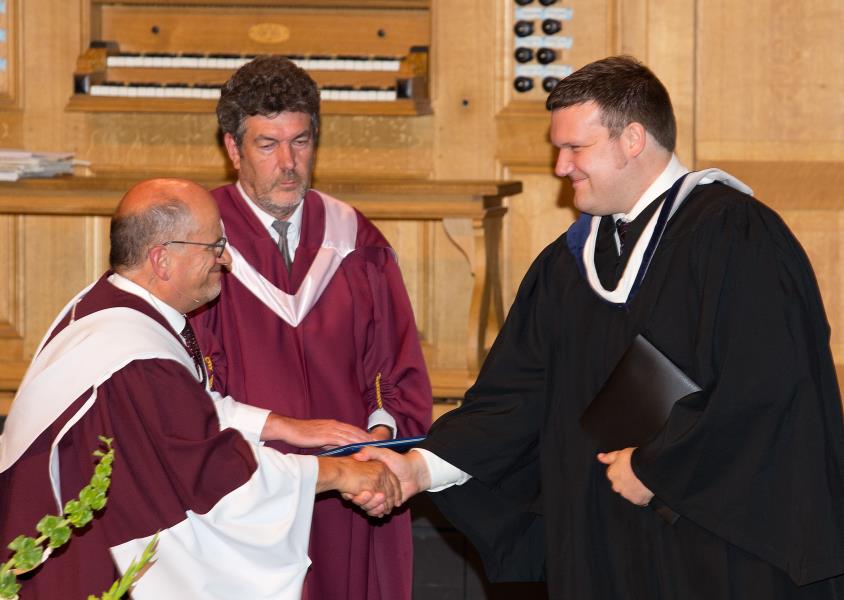
The 48th Anniversary and 43rd Convocation of the Canadian Reformed Theological Seminary. The keynote address “The Year of Jubilee” was given by Dr. J. Smith.
September 20, 2017
It began five hundred years ago and it still matters—someone rediscovered grace. What was the Great Reformation? Why did this change happen? This opening presentation will define the event, lament the errors of the medieval church, rejoice in the scriptural incentive for reform, and review the many ways the Spirit used the reformers (preaching, prayer, publications, psalm singing, etc.). A dynamic and exciting picture will emerge to motivate us to keep spreading the gospel of grace today. Audio only.
July 6, 2017The Reformation made it abundantly clear that we are saved by faith, not by works. At the same time, “faith is the assurance of things hoped for” (Heb. 11:1). But what if I don’t always feel so assured in my faith? Must I be certain in my faith to be certain of my salvation? Following John Calvin as our theological guide, we will explore the challenging terrain of faith, assurance, and justification, with a special focus on comforting those who struggle “with various doubts of the flesh” (Canons of Dort, 5.11). Audio only.
July 6, 2017
The overarching goal of early Reformed theology was the guarding of God’s glory. Early French-language reformers like Guillaume Farel and John Calvin focused their critique upon all teachings and practices that—whether directly or indirectly—in their view detracted from God’s glory. Late medieval Christianity in particular had established practices that diverted recognition from God to the person. Farel and Calvin maintained that one must listen to God himself via Scripture in order to understand how God’s glory is robbed and how it ought to be acknowledged. Thus the conference will close with Soli Deo Gloria.
July 6, 2017
Liberal views of the Bible see it as a book that is meant merely to inform rather than as the Spirit’s tool and power to transform. But when we lose confidence in the dynamic character of Scripture we would do well to listen to how the reformers grasped the living power of God’s Word. For reformer Ulrich Zwingli, the Bible was alive with soul-piercing, heart-discerning, life-giving potency. He believed that even the simplest person that approached God’s word with humble sincerity could come away with a rich knowledge of God, a deep inner delight in his grace, and a lively hope for the future.
July 6, 2017
Martin Luther was the most important theologian since Aquinas and the most original thinker since Augustine. His writings divided the western church, sparked revolts, and produced the greatest flurry of literature the world had ever seen. Perhaps no single person ever had more people trying to destroy his work and yet Luther was easily the most published man in the sixteenth century: what Luther wrote, Europe read. It is rare that we get to glimpse a giant, but in this lecture we’ll look at Luther for who he really was: a great man whose greatest accomplishment was to persuade a dying world that its only hope was a fresh understanding of the sufficiency of Christ’s person and work.
July 6, 2017